Where Do Contaminants in Food Come From?
Contaminants like heavy metals, PFAS, pesticide residues, and microplastics aren't on any label, because they enter food through how it's grown, raised, processed, and packaged rather than through the recipe. This post walks through where they come from at each step, and why testing is the only way to know what's actually in a given product.
You read ingredient lists. You compare nutrition panels. Maybe you even scan barcodes with an app. And you still don't know everything that's in your food.
That's because the chemicals that aren't meant to be there, things like heavy metals, PFAS, pesticide and herbicide residues, plasticizers, and microplastics, aren't listed on any nutrition label. They're contaminants: substances that end up in food not because anyone put them in the recipe, but because of how food is grown, raised, processed, packaged, and stored. No barcode scanner can detect them. The only way to know if they're there is to test.
For some contaminants, the health science is well developed and regulators have published reference values. For others, microplastics especially, the measurement methods themselves are still being standardized, and there's little agreement on what a given level means. In the meantime, a reasonable approach is a simple one: limit your exposure where you can. To do that, you need data.
What counts as a contaminant
A food contaminant is any substance present in food that wasn't intentionally added as a legitimate ingredient and that could harm human health.
Biological contaminants, such as bacteria, parasites, and viruses, are what most people mean by "food safety." They cause foodborne illness, and cooking, refrigeration, and safe handling are designed to address them.
Chemical contaminants are different. For the most part, they can't be cooked away. Washing may remove some surface residue, but it's hard to tell how much, and washing won't remove contaminants that are absorbed into the food. These contaminants are what Canopy tests for.
Where contaminants come from
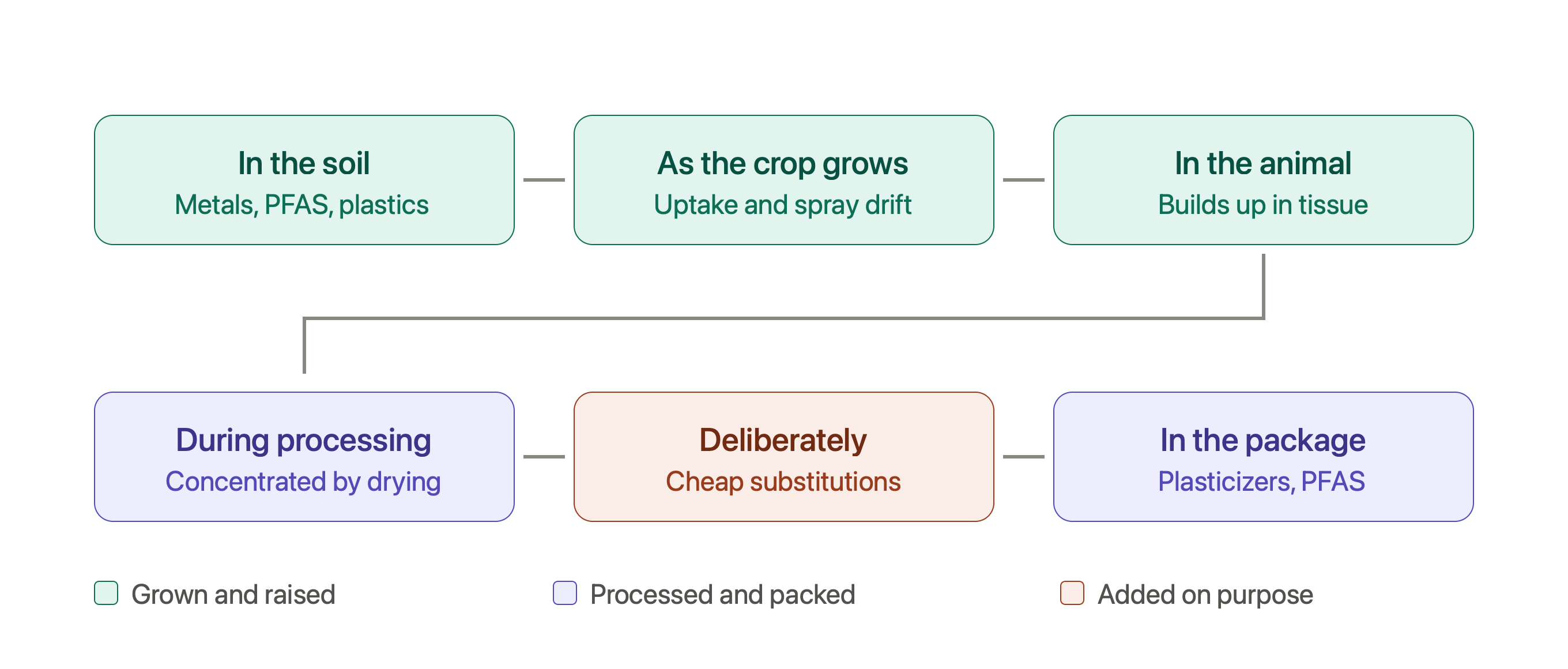
Food goes through many steps before it reaches the shelf. Contaminants can enter at any of them.
In the soil. Some contaminants are in the ground to begin with, and others arrive over the years through what gets applied to the field, what settles out of the air, and what comes in with the irrigation water. Many don't break down for decades, so what a field received in 1975 can still be there today.
Lead, arsenic, and cadmium occur naturally in the earth's crust. Every crop is grown in ground that contains some of these heavy metals, but human activity adds to that baseline through fertilizers, manure, soil amendments, and the legacy of leaded gasoline. Some pesticides banned decades ago are still in the soil today. PFAS reach farmland through treated sewage sludge (sold as biosolids fertilizer), contaminated groundwater used for irrigation, and runoff from industrial sites and firefighting foam, and they are stable enough that PFAS from one sludge application can show up in crops and livestock years later. Microplastics arrive through plastic mulch films that break apart in the field, fertilizer pellets with a plastic coating, compost and sludge that carry plastic fragments, and airborne particles that settle onto fields.
While the crop grows. A plant draws water and nutrients up through its roots, along with whatever else is dissolved in that water, and it collects whatever lands on its leaves and skin. How much reaches the edible part depends on the contaminant and on the type of plant.
Rice takes up arsenic more readily than other grains, because flooding a paddy frees arsenic from the soil into the water the roots draw from. Leafy greens and root vegetables generally pick up more metals than fruiting plants like tomatoes. Some PFAS move into leaves and stems more easily than others, so greens tend to carry more than fruit or grain from the same field. Pesticides and herbicides applied during the season leave residues that often remain at harvest, and spray drift from a neighboring field can land on a crop that was never intentionally treated.
While an animal lives. An animal eats and drinks in large volumes over months or years. Contaminants the animal can't break down or excrete build up in its tissue, so levels in meat, milk, eggs, or fish can be higher than the level in any one thing the animal ate.
Where those contaminants end up in the animal depends on their chemistry. Cadmium concentrates in the liver and kidneys, and older animals carry more. PFAS concentrate in the liver and blood and pass into milk and eggs. Dioxins and other fat-soluble compounds settle into fat, which is why they show up in whole milk, butter, and fatty cuts. Mercury builds as it moves up aquatic food webs, so a large predatory fish carries much more than a small one.
During processing. Two things can happen here. Contaminants already present get concentrated, and new ones get introduced.
Concentration: drying, pressing, and reducing remove water, and the contaminants stay behind. Whatever was spread through a pound of fresh food is now packed into a few ounces of powder, oil, or extract. Whether that raises your exposure depends on how much of it you eat, which is why we report results per serving.
Introduction: everything the food touches on its way through a facility can add something. Process water, lubricants, plastic tubing and conveyor belts, metal equipment surfaces, and the chemicals used to filter, bleach, and de-foam along the way all make contact, and grinding and abrasion shed particles from plastic parts. A finished product is also assembled from ingredients bought from other suppliers, each carrying its own history, so a company can run a clean facility and still receive an ingredient that picked up a contaminant several steps upstream.
Deliberately. Some contamination is added on purpose. Adulteration means putting something cheap into a valuable ingredient to stretch the volume, add weight, or improve the color. Spices, oils, and supplements are common targets because they sell for a lot by weight and the substitution is hard to see.
Documented cases include lead chromate added to turmeric for a brighter yellow and industrial dyes in chili powder. Because this depends on a supplier's choices rather than on the field, you can't anticipate it from the crop, the country of origin, or anything else on the package.
In the package. Packaging sits against food for weeks or months, and chemicals move out of the packaging and into the food. Heat, fat, acidity, and long storage all increase how much contaminant transfers to the food.
Phthalates and other plasticizers seep out of flexible plastics and process tubing. PFAS were widely used to give paper wrappers, microwave popcorn bags, and beige fiber takeout bowls their grease resistance. Manufacturers stopped selling those coatings for food contact in the US in 2024 and FDA withdrew the remaining authorizations in 2025, though PFAS are still authorized for nonstick coatings, equipment gaskets, and manufacturing aids, and imported packaging sits outside that phase-out. Lead can leach from solder, ceramic glazes, and some imported cans.
Knowing what to look for is the hard part
What contaminants may be present is not intuitive from looking at a product. Rice concentrates arsenic. Dairy and beef raised on land that received sewage sludge carry PFAS. Anything dried or pressed down into a powder, oil, or extract concentrates contaminants.
Pesticides and herbicides follow their own logic. Oats and wheat can carry glyphosate because some growers spray shortly before harvest to dry the crop down, so the residue arrives at the end of the season rather than during it. Systemic pesticides move inside the plant's tissue, so washing and peeling do little.
What a product is made of tells you which contaminants are worth looking for. Where it came from determines how much contaminant is there, and that part you can only find out by testing. That's why every contaminant test on Canopy comes with a description of which foods that contaminant tends to show up in and why. If you're wondering whether a product is worth testing, that's the place to start.
So why isn't this on the label?
Labels tell you what a manufacturer put into a product. Contaminants are what shouldn't be there, so they sit outside labeling requirements entirely. Contaminant levels are real, measurable, and vary between products. With testing data you can make lower-exposure choices based on what you're actually eating.
How Canopy works
A single lab test is expensive, but the answer is useful to everyone asking the same question. So people share the cost. Someone proposes a product and a contaminant, enough people fund it to cover the lab test, and the results go back to the funders and into our community dataset. We run every test with the same methodology, the same qualified laboratories, and the same level of detail.
See what's in the dataset, or fund a test, at forcanopy.com.