How We Test Food: A Walkthrough Using Our Cereal Glyphosate Data
How Canopy tests food, start to finish: buying products off the shelf, testing them at qualified labs, and displaying the results in context you can use. Our cereal glyphosate data as an example.
We tested four widely sold breakfast cereals for glyphosate: Quaker Oatmeal Squares, Cheerios, Nature's Path Heritage Flakes, and Fruity Pebbles. A single serving of one of the cereals delivers more than three and a half times a full day of the strictest health guideline for glyphosate. The other three each stay well under that limit. Which cereal is which, and the exact figures, are on the product pages on forcanopy.com.
But the number itself isn't really the point of this post. With contaminant testing, the method is what makes a result worth trusting. This post walks through exactly how we got these numbers, step by step, using the cereals above.
The dataset is small right now, and it's built to grow. If the cereal you actually buy isn't in it yet, you can change that (more on how at the end).
Why glyphosate, why cereals
Glyphosate is the active ingredient in Roundup and the most widely used herbicide in the world. It's sprayed directly on glyphosate-tolerant crops (corn, soy, canola) to kill weeds, and it's used as a pre-harvest desiccant on grains like oats and wheat, sprayed shortly before harvest to dry the crop down for combining. That pre-harvest step is the main reason glyphosate residues show up in oat-based products like breakfast cereal.
Different organizations disagree, sharply, about how much glyphosate is acceptable to consume, and that disagreement is what the chart further down illustrates. The Environmental Working Group (EWG) sits at the strict end: it argues the amounts appropriate for products marketed to children are far lower than U.S. rules require, and bases its benchmark on cancer-risk assessments, which works out to about 10 micrograms of glyphosate a day. It sued the EPA in April 2026 over the agency's seven-year delay in responding to its petition on the issue. The EPA's own guidance is the most permissive of the four we plot; Prop 65 and EFSA fall in between.
It's worth knowing how generous the U.S. ceiling can be. The EPA number you'll most often see cited, its tolerance of 30 mg/kg for glyphosate in oats, is a cap on concentration of glyphosate in the crop, not a daily-intake guideline, so it's a different kind of number than the chart uses. But it's a telling one: that tolerance was 0.1 mg/kg in the early 1990s and has been raised repeatedly since.
We are not going to resolve that disagreement. What we can do is measure what's actually in the cereal, show you where it lands against several of these benchmarks, and let you decide which one you want to follow.
We tested each of the four for both glyphosate and AMPA, glyphosate's primary breakdown product, which is itself biologically active. The four span heavily oat-based products, a rice-based one, and a certified-organic option, which made them a useful first batch. The dataset gets more useful as it grows, and the next products in it are going to be the ones our community asks for.
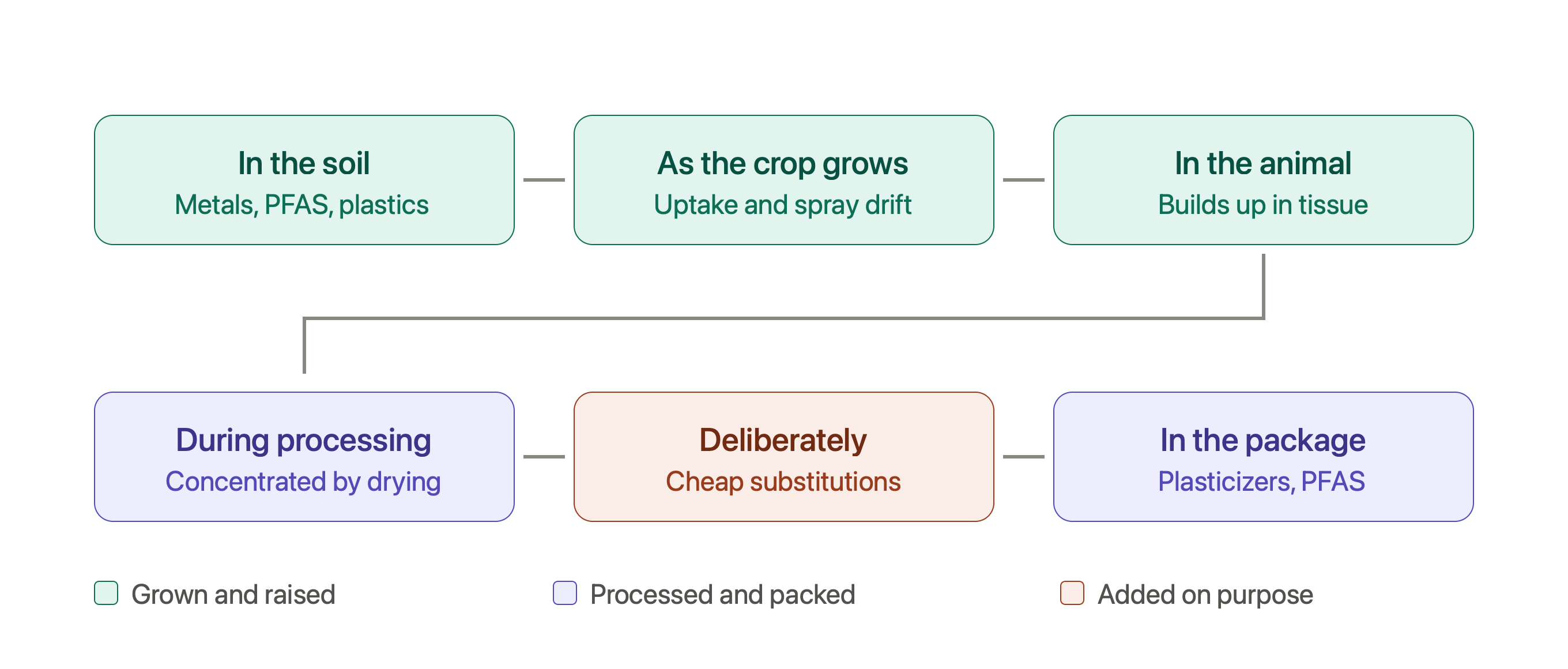
Step 1: We bought every cereal at retail.
Every box was purchased at a regular grocery store, the same way any consumer would. We don't accept samples from manufacturers, and we don't accept samples from anyone with a stake in the outcome. We documented the store, date, and lot number printed on each box, and photographed the packaging. That paper trail is called chain of custody, and it lets anyone reviewing our results verify that the cereal we tested is the same cereal on the shelf.
For this study, we purchased samples between April 6 and April 14, 2026, from two retail locations in Northern California.
Step 2: We sent samples to a qualified lab.
Canopy doesn't run its own laboratory. We sent these samples to one of the commercial laboratories in our network. We work only with qualified laboratories: labs whose methods, equipment, staff training, and quality-control procedures have been independently vetted, and that can demonstrate they produce accurate, reproducible results. In practice that often means third-party accreditation, but it can also mean an academic or university lab when that's what it takes to reach the lowest detection limits. What matters to us is that the lab can stand behind its numbers.
Step 3: The lab used a standardized method.
For glyphosate and AMPA, the standard analytical method is LC-MS/MS (liquid chromatography paired with tandem mass spectrometry) which can detect both compounds at very low concentrations, with a detection limit of 0.010 mg/kg for both glyphosate and AMPA. Anything below that concentration is reported as "not detected," which doesn't mean zero; it means below the level the instrument can reliably measure.
Step 4: We share the results with our community.
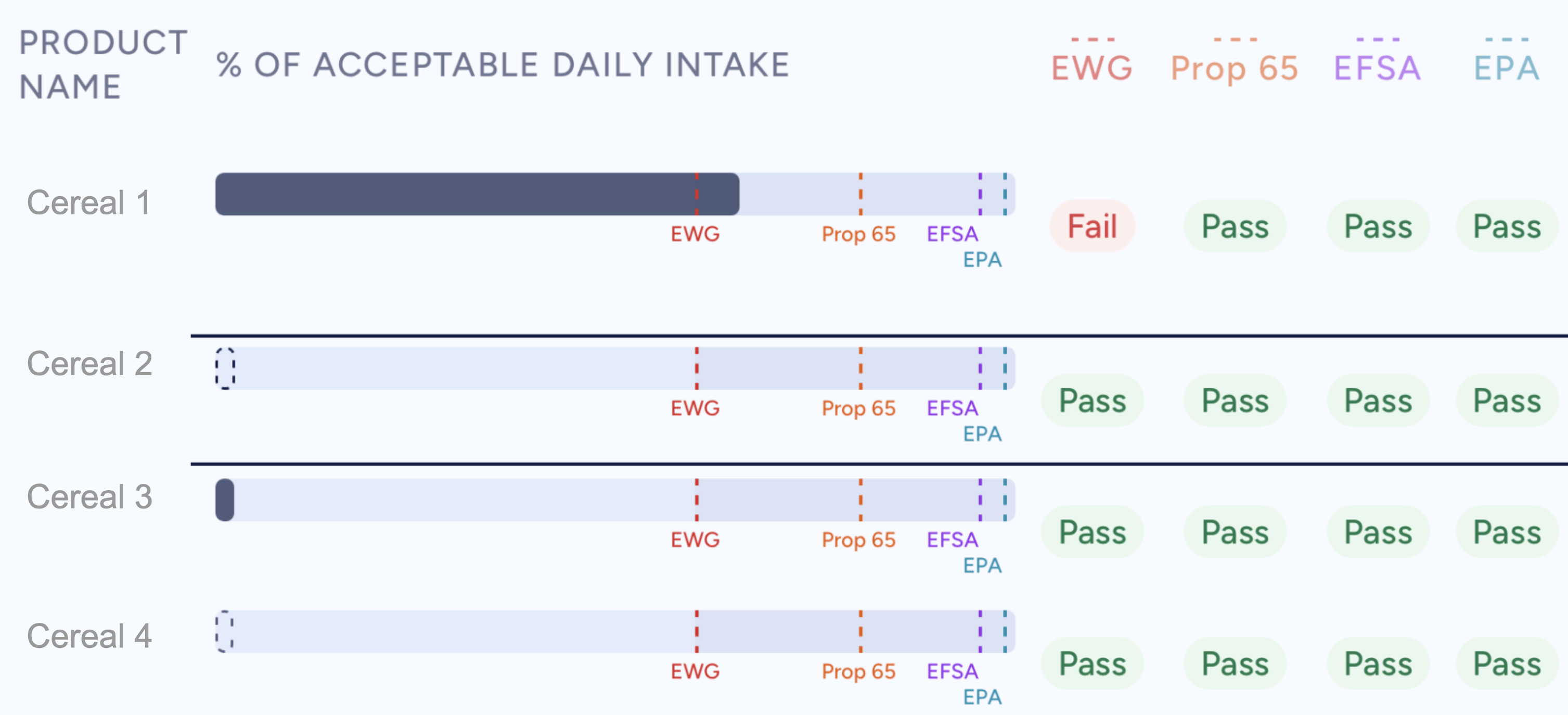
The bar plot shows how the cereals tested compare at a glance. Full results live on the product pages on forcanopy.com. See "How we display the data" below for more information about how the results are shown.
How we display the data
The bar plot isn't showing raw concentration; it's showing exposure. The difference matters.
The lab gives us a concentration: how much glyphosate is in the cereal, in mg of contaminant per kg of cereal. On its own, that number is hard to act on, because what actually reaches a person depends on how much they eat. So we convert it. We take the measured concentration, scale it to a standard serving of that cereal, and calculate how much glyphosate a single serving really delivers.
Then we compare that per-serving amount to daily-intake health guidance: the amount different organizations consider acceptable to consume in a day. Each bar shows what share of that daily guidance one serving represents. We plot four reference points because these groups don't agree: EWG sets the strictest, followed by Prop 65 and EFSA, with the EPA the most permissive. A cereal "passes" a given benchmark when a serving stays under that group's daily guidance, and "fails" when a serving alone would exceed it.
Two things worth being clear about. First, this is a per-serving, per-day comparison against guidance that itself varies widely. It's a way to see how a normal serving stacks up, not a verdict that a food is "safe" or "unsafe." Second, the serving size and intake assumptions behind each chart are listed alongside it, so you can check our math or substitute your own.
The raw laboratory concentrations for every product, the underlying mg/kg numbers, brand by brand, are available on each product's page under Raw Laboratory Results. We keep the brand-by-brand numbers there, behind our terms of use, rather than in posts like this one.
What the numbers show
A few things stand out in this dataset.
The spread is the headline. Measured as exposure, a single serving of the outlier delivers about 357% of EWG's daily guidance, more than three and a half days' worth of the strictest benchmark in one bowl. In two of the four cereals, glyphosate wasn't detected at all: any that was present sat below the level the lab can reliably measure (a detection limit of 0.010 mg/kg). Between the outlier and those non-detect cereals, the difference in glyphosate per serving is roughly 100-fold. That gap is the real takeaway: differences between products are large and measurable, and a single cereal accounted for nearly all the exposure we found. The results at the low end show that producing cereal with far less glyphosate in it is entirely achievable.
The outlier was also the only product where we detected AMPA at all, glyphosate's primary breakdown product, which is itself biologically active. Finding both the parent compound and its metabolite in the same cereal is a sign the contamination has been present long enough for some of it to start degrading somewhere along the supply chain.
Against the benchmarks, only that one outlier crossed any line at all, and only the strictest one. Its single serving exceeded EWG's daily guidance, but still came in under the Prop 65, EFSA, and EPA daily-intake thresholds. Every other cereal passed all four.
The pattern behind all of this is well established. Glyphosate concentrates in oat-based products because pre-harvest desiccation is far more common on oats than on grains like rice, which is why a rice-based cereal returning non-detect is exactly what you'd expect. And while a certified-organic label limits intentional use, it doesn't guarantee zero residue: drift from neighboring conventional farms, contamination at shared processing facilities, and trace residues in supply chains are all documented ways organic products pick up glyphosate. One of the non-detect results in our set came from an organic oat cereal, evidence that very low residue is achievable, not proof that "organic" is a guarantee.
We are not resolving the disagreement between these benchmarks, and we are not telling you which cereal to buy. Where a household draws its own line (EWG's stricter benchmark, the EPA's more permissive one, or somewhere in between) is yours to decide. What the data makes clear is that exposure varies widely between products, and that the low end is achievable.
To see which of the four cereals produced which result (including the one whose single serving runs past a full day of the strictest guideline) and where your own cereal lands, open the product pages on forcanopy.com.
One test is a snapshot.
The results above come from a single test of a single box. That's a real data point, but it's one moment in a supply chain that changes. Different harvests, different lots, and different desiccation practices can all move the number. A cereal that reads clean once can read differently next quarter, and vice versa.
If a result here matters to you (because it's the cereal in your pantry, or because you want to know whether a number holds up), one of the most useful things you can do is fund a follow-up test. A second data point turns a snapshot into a trend.
Add your cereal to the dataset.
There are dozens of widely sold cereals we haven't tested yet, and the ones that get tested next are going to be the ones our community tells us they care about.
If the cereal you actually feed your family isn't in the dataset yet, you can change that. At https://www.forcanopy.com/test-requests/new you can propose a product for testing and start a small fundraising campaign to cover the lab cost. When a campaign hits its target, the testing happens. When the results come back, they join our community dataset alongside the four products above: same methodology, same qualified lab, same level of detail.
You don't need to fund a test on your own. Most of these campaigns are pooled efforts: someone proposes a product, a few dozen people who care about the same product split the cost, and the result enters the dataset for everyone in the community. The next post is about why this model is the only way we know to make this kind of data exist at all.
forcanopy.com