What Organic vs. Conventional Doesn't Tell You About Pesticide Exposure: Our Current Blueberry Data
Blueberries from four brands tested for pesticides show that conventional products can vary more from each other than they do from organic ones, and that the same result can look very different depending on whether it's scaled to an adult's or a child's body weight.
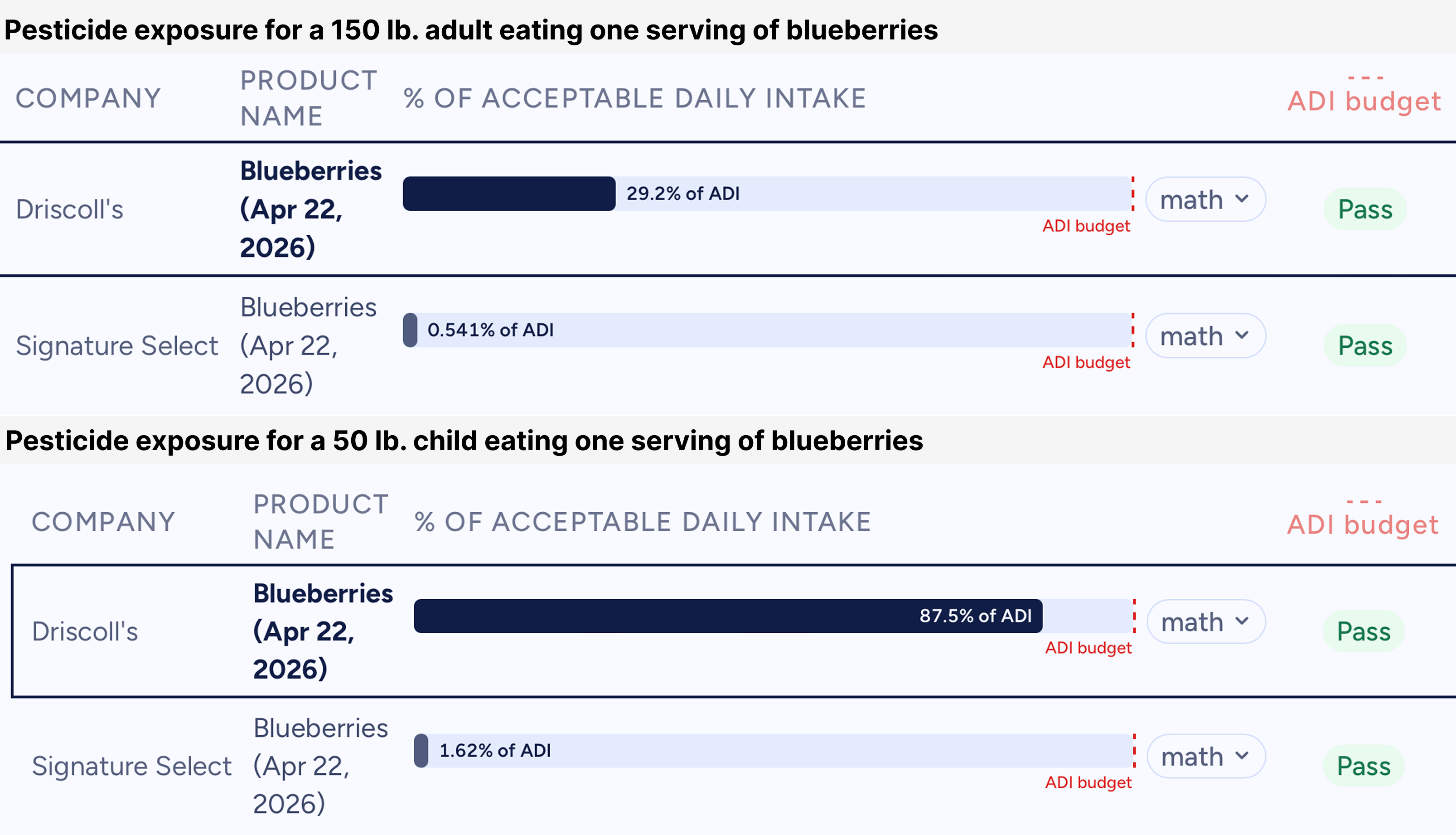
Driscoll's blueberries, tested April 22, 2026, come in at 29.2% of the acceptable daily intake (ADI) for pesticides, for a 150 lb adult. For a 50 lb child eating the same serving of the same berries, that number jumps to 87.5%. Same product, same test, same pesticide residues. The only thing that changed is who's eating it.
Why body weight changes the math
ADI is a dose per kilogram of body weight, not a fixed amount. We use ADIs published by the European Food Safety Authority (EFSA), which derives them from animal toxicology studies: researchers identify the highest dose with no observed adverse effect, then divide it by a safety factor (typically 100) to account for differences between animals and humans and between individuals. Because the resulting number is expressed per kilogram, the same absolute amount of a pesticide takes up a much bigger share of a smaller person's budget. A 50 lb child weighs about a third of a 150 lb adult, so the same residue level in the same serving uses up roughly three times as much of their daily allowance. That's the entire mechanism behind the gap above.
Four products with very different results
We tested four blueberry products, purchased locally, for a panel of 583+ pesticides: Driscoll's and Signature Select (both conventional), and Green Belle and Berry Fresh (both organic). No pesticides were detected in either organic product, consistent with the organic label. For a 150 lb. adult, Signature Select comes in at 0.541% of ADI. All four pass. But Driscoll's, at 29.2%, is more than 50 times higher than Signature Select, even though both are conventionally grown.
That variation is the actual finding here: this data doesn't say "buy organic" (although that is the lowest exposure choice). It says pesticide exposure varies substantially between brands within the same growing practice, and that variation is bigger than the gap between conventional and organic in this sample. Signature Select's number looks a lot more like the organic products' than like Driscoll's. Whatever's driving that difference, sourcing, farming region, specific pesticide programs, it isn't as simple as a conventional/organic label.
One pesticide, zeta-cypermethrin, accounts for 22.7% of Driscoll's summed ADI on its own. So this isn't just a story about blueberries carrying pesticides in general, it's about one compound showing up at a meaningfully higher level in one product than in the others we tested.
How we calculate the combined number
For chemicals that act through a shared mechanism, it's an accepted practice to sum their individual ADIs into a combined hazard estimate. We take a broader approach: we sum the ADIs of every pesticide we detect in a sample, whether or not each pair shares a mechanism, because it gives a single, easy-to-compare number across products. That's a simplification; health impacts don't necessarily add up cleanly across different mechanisms of action, and we want to be clear about it. The full breakdown by individual pesticide is available in the math dropdown or raw lab results for anyone who wants to reason about the data differently than our summary number does.
What this number does, and doesn't, cover
Two things worth keeping in mind. First, this reflects a single serving; eating more or less scales the exposure proportionally. Second, this is only one of the foods a person eats in a day; pesticide exposure adds up across a whole diet, so this result is one data point in a much larger picture, not a full accounting of anyone's total exposure.
Who this matters most for
The adult number and the child number are both real, they just answer different questions. If you're mostly feeding adults, the 150 lb scaling is the more relevant one. If you're buying for young kids specifically, the child scaling is worth paying closer attention to, since it's their actual exposure that matters, not an adult's.
The takeaway
The point isn't that Driscoll's blueberries are unsafe; all four products pass at both body weights compared. The point is that assumptions based on category (organic vs. conventional) aren't the only predictor of your pesticide exposure; you also need brand-level, ingredient-specific data. That's the gap Canopy's testing is built to fill. The full per-pesticide breakdown for all four products is available for blueberries by scrolling down on the data page of any of the blueberries we've tested: https://www.forcanopy.com/test-requests/2824d58b-08eb-4ac2-b7a4-e61f30652c73
—forcanopy.com
Ready to pool in? Open tests are waiting for backers right now.
Browse open tests →