Why test for Pesticide Screen?
Screens for common pesticide residues including organophosphates, pyrethroids, and neonicotinoids — neuroactive compounds that regulators limit because of documented health concerns, including effects studied most closely in children. None of it appears on the label, and levels can vary between products.
Requested by
momof2
How Canopy shares data — Pesticide Screen
A concentration on its own doesn't tell you much — what matters for health is the dose, how much you actually take in. So each bar shows the amount of contaminant in a single serving (the lab's concentration × the labeled serving size, with raw numbers below), measured against daily-intake guidance from several organizations — some of which scales with body weight, so you can enter different weights for yourself or your household. And because we compare products within the same category and subcategory, you can see how similar options stack up and pick a lower-contaminant one.
Enter your body weight
Health limits that scale with body weight recalculate everywhere below. Kept for this session only — not saved to your account.
| Photo | Company | Product Name | % of Acceptable Daily Intake | ADI budget | Trend | View |
|---|---|---|---|---|---|---|
 | Driscoll's | Blueberries (Apr 22, 2026) | 28.4% of ADI ADI budget | Pass | Single Test | → |
 | Signature Select | Blueberries (Apr 22, 2026) | 0.525% of ADI ADI budget | Pass | Single Test | → |
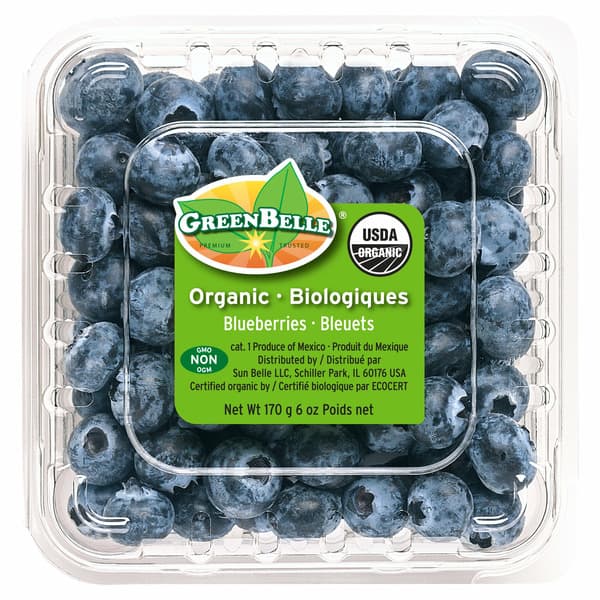
 | Green Belle | Organic Blueberries (Apr 22, 2026) | 0% of ADI ADI budget | Pass | Single Test | → |
 | Berry Fresh | Organic Blueberries (Apr 22, 2026) | 0% of ADI ADI budget | Pass | Single Test | → |
Percent of ADI is calculated for each pesticide detected and the percentages are then summed to give a total for easy comparison. Products are graphed and sorted by these totals. Click the math button on any product to see each detected pesticide's contribution to the total. A product at 0% of ADI has no scored residue burden — nothing was detected, or every detected residue has no published EFSA ADI to score it against — so its bar is shown dotted rather than filled.
More info about Pesticide Screen
How The Test Is Performed
The food sample is blended and cleaned up using a quick preparation method called QuEChERS ("catchers"). The extract is then passed through GC-MS and LC-MS/MS that can separate and identify hundreds of different pesticides in a single run — like scanning a crowd and recognizing hundreds of faces at once.
Good foods to test
- Strawberries & berries
- Apples & stone fruit
- Leafy greens (spinach, kale, lettuce)
- Grapes & raisins
- Bell peppers & hot peppers
- Tomatoes
- Oats & wheat products